
Anyone who trains regularly knows the feeling of muscle tension that won't let go despite stretching, rolling and massage. Your body rebels and you feel frustration instead of progress. Maybe you've tried everything - except what really works with surprising speed and without the use of needles. What if there is a method that literally 'turns on' the nervous system and resets tensions? Could pinopressure in athletes be an effective answer to tense muscles?
How does pinopressure work?
Pinopressure is a manual technique developed by a Polish doctor - Radosław Składowski. It combines elements of reflexotherapy, acupressure and neurology. However, it differs from classical methods in that it does not use needles, but special tools - pins (i.e. brass nails) and katas. The aim is not to puncture the skin, but to apply pressure to the skin at appropriate points - usually along the course of nerves or in reflex zones.
The treatment looks inconspicuous, but the body's response can be spectacular. The nervous system receives a 'corrective stimulus' that can extinguish chronic tension, improve circulation and release range of movement. In practice - after one session, an athlete can regain the mobility they haven't had for months.
Unlike dry needling or classic acupuncture, pinopressure in athletes does not affect tissue continuity. There is no bruising, swelling or risk of infection. It works strongly but non-invasively.
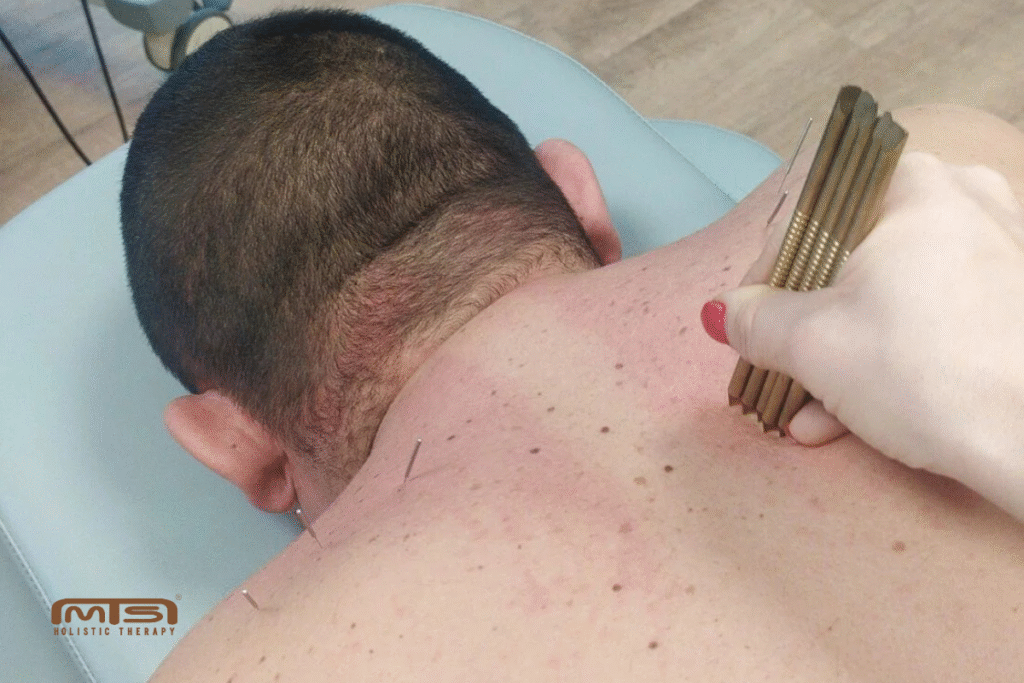
Pinopressure is an effective, non-invasive manual therapy for athletes and active people. It helps reduce tension, pain and improves mobility without the use of needles.
Pinopressure in athletes - when is it worth using?
Pinopressure treatment in athletes is not just for professionals. It also works successfully for recreational trainees who struggle with chronic muscle tension or who experience movement restrictions despite regular mobility work. If you feel like your body is 'locking up' for no apparent reason and traditional methods are no longer working - this is a sign that pinopressure is worth considering. When does pinopressure in athletes have the best effect?
- Persistent muscle tension despite stretching
When muscles remain hard, stiff and painful despite regular stretching. - Pain during movement without injury
If there is discomfort during exercise, even though no injury has occurred - this could be a signal of nervous system overload. - Frequent micro-injuries and overloading
Minor complaints that keep recurring (e.g. knee, shoulder or back pain) may be due to unseen tensions. - Blocked ranges of motion
Limited mobility despite working on technique? Pinopressure can 'unblock' the body after just the first session. - Slow recovery after training
Do you feel that your body needs more and more time to recover? This could be the result of chronic neuromuscular tension. - No progress despite a well-chosen plan
Are you training according to plan and yet your form is stagnant? Your nervous system may be overloaded and in need of a reset.
In addition, pinopressure in athletes works well as a preventative element. Regular sessions help remove tension before it develops into an injury, promote recovery and keep the body ready for further exercise.
Pinopressure in athletes - on which parts does it work most effectively?
Although it can be applied to virtually the entire body, certain areas respond particularly well. In athletes, it is most commonly worked with:
- neck and hamstring muscles - especially for those training in strength or contact sports
- shoulder girdle - especially in swimmers, climbers, combat sports competitors
- the lumbar region - a lifesaver for runners, cyclists and triathletes
- the iliotibial band and adductors - sensitive areas for footballers and runners
- feet and Achilles tendon - for those training on hard surfaces
This is where tension accumulates that is difficult to relax with a simple massage or stretching. Pinopressure acts a bit like a reboot - it allows the muscles to 'remember' that they can relax.
Importantly, the treatment does not have to be painful. A skilled therapist can adjust the amount of pressure to the patient's tension level and pain threshold. Many athletes report that pinopressure produces more pronounced effects than a classic deep massage - with much less discomfort.
Pinopressure in the programme MTS4RUN is an effective and non-invasive method to support runners in reducing tension, improving movement patterns and faster recovery after training.
Examples of post-treatment effects
Here is what athletes often report after just one or a few pinopressure sessions:
- feeling of "light legs" or "lighter body"
- increased range of movement - e.g. deeper squat, looser shoulder
- reduction of pain - even chronic and recurrent pain
- improving proprioception, i.e. a better sense of the body in space
- improve sleep quality and post-workout recovery
- faster recovery from micro-injuries
Pinopressure in athletes has another advantage - it not only works locally, but also systemically. By affecting the nervous system, it can reduce stress levels, improve the digestive system or regulate muscle tension throughout the body. Some athletes use it before competitions - to improve body sensation and concentration. Others treat it as a regular part of their recovery week.
Pinopressure in athletes is not a fad or an exotic ritual. It is a proven and concrete method that can work wonders where other techniques fail. If your body says something is "blocked" and you want to act non-invasively, quickly and effectively - it is worth giving it a chance.
FAQ
No. The treatment can be intense but should not be painful. The therapist adjusts the pressure according to your sensitivity.
Typically 30-45 minutes, depending on the area treated and individual needs.
Many athletes feel a marked improvement after the first treatment - greater range of movement, less pain, a feeling of a 'looser' body.
Yes. It is a completely non-invasive method - it does not disturb the skin or tissues. Also suitable for contraindications to classic massage.
For anyone active - runners, strength trainers, amateurs and professionals. Great for stretches, overloads and as part of recovery.



