A runner comes in and says: „I can't take this stinging on the side of my knee anymore”. Familiar, right? The iliotibial band is making its presence known again. ITBS - or iliotibial band syndrome - is a classic in the sporting world, especially in runners, triathletes and cyclists. Although many therapists automatically reach for stretching and rolling, it is increasingly being found to be not a tight band but an overactive nervous system sustains the pain. And this is where knee pinopressure - a method that makes it possible, in a few minutes, to calm over-reactive points and restore normal tissue gliding.
Mechanics of ITBS and typical therapeutic errors
Let's start with the basics. ITBS is not a „contracted band”, although it is so often referred to. The iliotibial band itself is a tendon-like structure - strong, thick and not very stretchable. The problem is not its length, but the way in which it wide fascia stretcher i gluteus maximus communicate with the nervous system.
When these muscles are overactive and the lateral aspect of the thigh is „glued” to the femur, friction and micro-tears in the lateral epicondyle area create local inflammation.
The most common error in therapy?
- Treating ITBS as a structural rather than a functional problem.
- Aggressive stretching of the band and compression of the lateral thigh with a roller.
- Overlooking control of pelvic rotation and foot positioning during the support phase.
It is not the tape that needs „stretching”, but the the nervous system needs reprogramming. If the patient can barely walk after 15 minutes of rolling and the pain returns after training - this is a sign that the approach needs to be changed.
Pins as a rapid neuromodulatory stimulus
Right here pinopressure shows its full potential.
Instead of acting mechanically, the pins interact at the neurophysiological level - are micro-pulses that modify the conduction in nerve endings and „reset” erroneous tension patterns.
When you apply the pin in the region of the greater ileum, lateral edge of the thigh and band, you trigger a reflex response: the muscles stop „holding” and there is that characteristic warmth. The patient is relieved and you see the range of movement return without forceful stretching.
The operation of the pins is fast because it is based on natural mechanisms neuromodulation.
There is no need to pierce the skin as with dry needle therapy - just a few points of precise depth and direction are enough for the motor system to start reorganising itself.
In practice:
- The lateral part of the thigh „lets go”,
- hip external rotation improves immediately,
- the patient comes off the table with a feeling of lightness in the leg.
There is no magic here - it is pure neurophysiology. A high-precision mechanical stimulus activates sensory fibres that inhibit excessive motoneuron activity. This allows the tension in the lateral band to normalise without „stretching” a structure that cannot be stretched anyway.
- Preliminary tests
Ober's test - shows the limitation of the glide between the band and the thigh. Hip internal rotation test - often shortened by gluteal compensations. Single leg squat dynamic test - reveals collapse of the knee inwards (valgo). - Three points that make a difference
The greater curvature - this is where the problem begins. Stimulate the lateral edge of the ileum and upper band to release tension in the broad fascia stressor attachment. Lateral thigh - middle third - this is where excessive fascial tension usually accumulates. The pins aligned along the muscle fibres change the tonus almost immediately. Lateral epicondyle area - this point often „burns” on compression, but working it out can instantly calm knee pain.
It's not about strength, it's about sequence and direction. First relax, then reset, finally activate. After a pin session, it's worth checking the Ober test again - the difference can sometimes be spectacular.
How to consolidate the effect (movement + taping)
Pinopressure is a boost. But if the patient goes back to running with the same biomechanics after leaving the surgery, the effect will disappear within a week.
Therefore, after the session, it is worth introducing integration exercises - simple, functional ones that restore control in the pelvic-knee-foot chain.
Exercise suggestions:
- Side step with rubber - activation of the gluteus medius and knee control.
- Single leg bridge with external rotation - strengthens hip stabilisation.
- Squat with pause and descent control - re-education of movement without excessive strain on the lateral band.
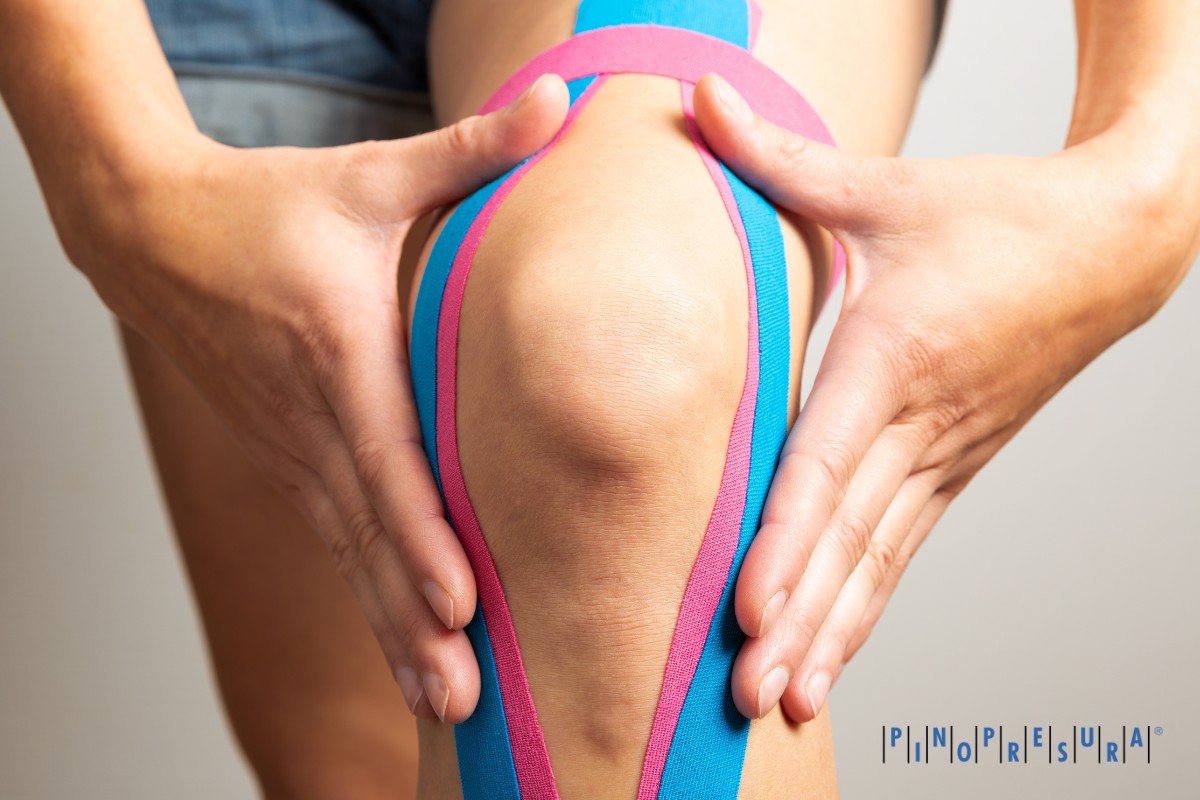
To this hip and tibial band taping, but not in the role of „bracing”. The tapes are there to remind the nervous system of the new pattern.
One application along the band, another laterally in the epicondyle region - this is often enough to maintain the effect of the therapy for several days.
It is also worth checking the patient's footwear and running track.
Shoes that are too narrow, poor cushioning or running exclusively on asphalt often provoke a return of symptoms.
ITBS under control - an effective therapeutic strategy
ITBS is not „overload syndrome” in the classic sense. It is misunderstanding between the nervous system and tissues, which are starting to go into defensive mode.
Pinopressure of the knee gives the physiotherapist a tool to reset this misinformation and restore flexibility to the tissues in a matter of minutes.
You will get the best results when you combine the three elements:
- Precise pinopressure points on the side tape,
- Re-education exercises to improve pelvic control,
- Conscious return to running loads.
When the patient first gets up from the recliner and says: „Wow, it's like someone unhooked the tension from my whole leg”.” - you know you are on the right path.
If this problem sounds familiar - make an appointment at MTS Holistic Therapy. We help athletes get back into shape faster, more effectively and without pain.
FAQ
Not straightforward. EPTE electrolysis works deep at the site of tissue damage and is great for tendinopathies. Pinopressure, on the other hand, works faster at the level of neuromodulation - resetting tension and improving movement pattern. In practice, the two methods can be combined: EPTE for tissue regeneration, pinopressure for nervous system control.
Always start gently - the key is direction and rhythm, not force. If you see a tissue response (micro-irritation, warming, spontaneous relaxation), this is a sign that you have reached the therapeutic threshold. Too much pressure can overload the pain receptors and cause reflex tension.
Yes, it is even worth it. After a well-executed pin session, a 24-hour break is recommended to allow the nervous system to „record” the new pattern. This is followed by low-intensity training (jogging, marching, hip mobilisation). This allows the body to learn to function in a new, less tense pattern.