
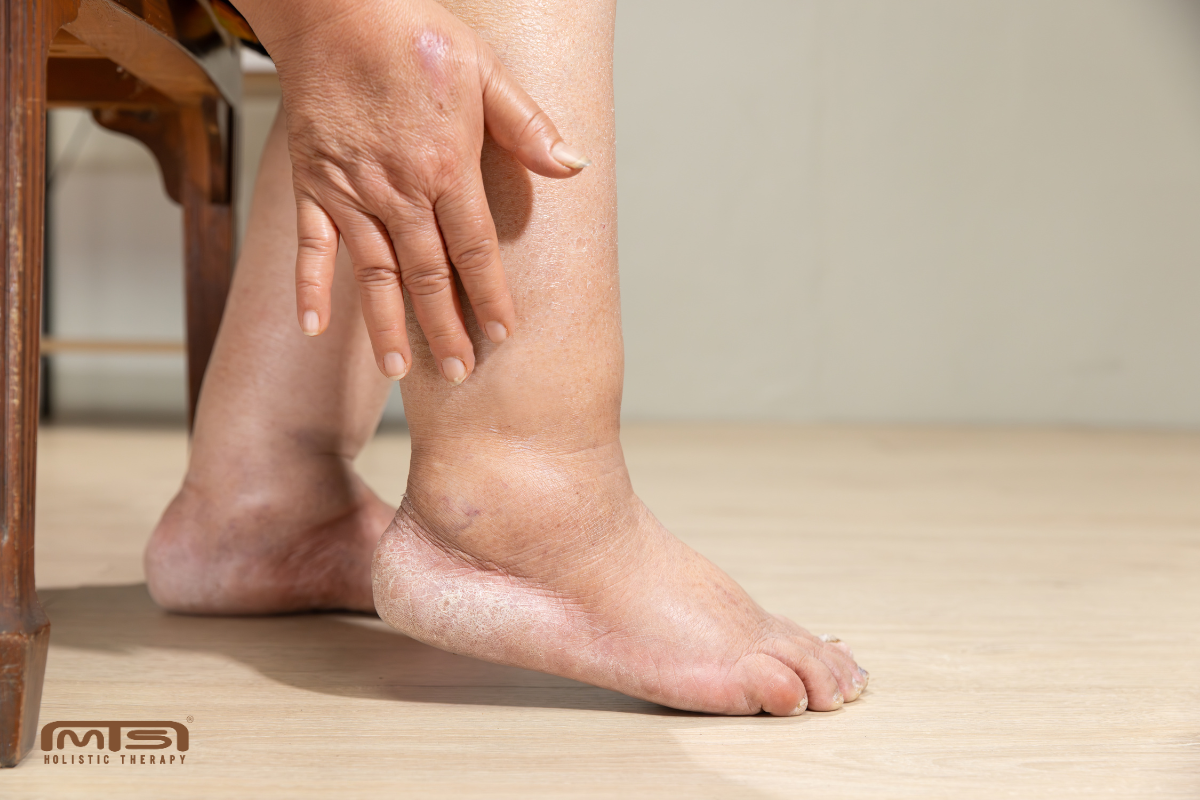
About 23% Poles at the age of about 40 years regularly experiences pain in the lumbosacral region of the spine. Through the busyness of work and daily errands, we try to ignore this pain. However, did you know that chronic back pain can cause other serious conditions?
You know that tingling sensation in your toes? It can certainly worry you, especially when it occurs suddenly, for no apparent reason. We often look for the fault in the foot itself - we suspect bad footwear, overloading, circulation problems. Well, numbness in the toes can originate much higher up, more specifically in the early mentioned spine!
Lumbar spine - the command centre of sensation in the legs
The lumbar spine, particularly its lower segments, plays an incredibly important role in the conduction of nerve impulses to the legs. Nerves emerge from this segment and branch out further to the sciatic nerve and other smaller branches responsible for sensation in the fingers. When there is pressure or irritation of these structures, one of the first symptoms can be numbness in the fingers. Especially of the pinky finger, second finger or little finger, depending on the level of damage.
Nerve conduction disturbances can also lead to:
- Degenerative changes,
- intervertebral disc herniation,
- segmental instability.
However, it's not just the physical pressure - inflammatory changes that cause local swelling and secondarily disrupt nerve function are often the problem.
The fascial system and numbness in the toes
We often focus all our attention on the spine, forgetting about the fascial system. It is what connects the musculoskeletal structures from the feet to the head. The thoracolumbar fascia is a huge connective tissue structure that not only stabilises the trunk, but also influences muscle tone in the lower back and lower limbs.
If the tension within this fascia is disturbed, especially chronic overload, surgical scars or asymmetrical muscle activation (e.g. after sitting for a long time), so-called fascial syndromes can occur. One of their symptoms is numbness in the fingers, resulting not from damage to the nerve, but from its mechanical irritation by overly tense surrounding tissue.
Numbness of the toes in root syndromes

The sciatic nerve, which runs from the lumbar region to the foot, can be compressed at various levels. In the spine, in the piriformis muscle and even in the popliteal fascia. In the classic form of sciatica, the patient may experience not only numbness in the toes, but also a burning pain radiating from the lumbar region down the leg. Symptoms are exacerbated with prolonged sitting, bending over or coughing - all of which increase the pressure inside the spinal canal, worsening the symptoms.
Numbness in the toes as a signal of an overloaded nervous system
It is not only structural changes that can cause numbness in the toes. An increasing number of studies are highlighting to overload of the nervous system as a result of chronic stress, lack of regeneration and muscular tension. A nervous system that does not have adequate conditions for 'rest' can react with neurological symptoms that at first glance look like organic damage.
In such cases, the MRI image may be normal, but the patient still feels tingling, burning or numbness in the fingers. This is known as dysfunction of the nervous system at the functional level - its ability to adapt and conduct information is disrupted by emotional or mechanical tension.
It's not just a leg problem!
Numbness in the fingers is an alarm signal that rarely only affects the feet. The human body functions as a whole - disorders in one area can result in symptoms in a completely different area. This is why a holistic approach to the diagnosis and treatment of such symptoms is so important. Have your toes really been numbed by ill-fitting shoes? Or has your spine been sending signals for a long time that you haven't yet deciphered?
Read also:
Numbness in the fingers - analysis of causes

The tingling or numbness in the fingers usually goes away on its own, but in some cases it can signal a more serious health problem. The most common cause is degenerative changes in the spine, particularly in the cervical region. Another possible cause is carpal tunnel syndrome, although this symptom can also accompany neurological conditions.
Treatment
- Rehabilitation of the lower limb In such cases, it is not limited to foot exercises - it is important to restore normal lumbosacral mobility and pelvic stabilisation.
- Manual therapy, spinal mobilisations, as well as specialised neuromobilisation exercises can effectively reduce pressure on nerve structures.
- In addition, deep tissue massage and fascial work techniques help to relax overstressed structures and improve nerve conduction.