
Many healthy people use various types of training to keep fit. However, sometimes fitness is lost due to accidents or illnesses. Then the best solution is appropriate rehabilitation. So what are the modern training methods currently in use?
What is the difference between personal training and medical training?
Personal training is one-to-one instruction under the guidance of a qualified trainer, Among the most popular training include:
- FORCE,
- slimming,
- functional
- general development
However, medical training is personal training combined with rehabilitation. These classes aim to eliminate dysfunctions and the weakest links in the body. Its main feature is the use of functional exercises to help with everyday activities. In addition, it is suitable for people who want to feel better and improve their overall fitness. Both types can use modern training methods.
What is medical training useful for?
The main principles of medical training are:
- improving deep sensation and body awareness,
- restoring the correct muscle tone,
- improving the range of movement in the joints,
- strengthening muscle strength and coordination,
- eliminating bad movement patterns,
- improving mobility,
- development of stability,
- injury prevention.

What are the modern training methods?
Modern rehabilitation-related training methods vary widely and depend on the needs of the patient. These include:
Kinesitherapy
It is is treatment through movement. The treatments are designed for people during rehabilitation of the musculoskeletal system, but can also be used for respiratory or nervous system disorders. Main types of treatment is an exercise:
- passive during which the patient is rehabilitated by a physiotherapist,
- supported,
- active - performanceused via patienta,
- in relief -serve reductioni joint or muscle strain,
- instrumental kinesitherapy - is the performance of exercises using instruments, such as a bicycle, treadmill, cycloergometer, atlas or orbiter,
- a set of special exercises,
- compensatory gymnastics,
- corrective gymnastics,
Bobath method
It is is a rehabilitation method that is used with both adults and children. Its The aim is to improve the patient's mobility by eliminating abnormal reflexes and by having an appropriate effect on their muscle tone. It is used for patients with cerebral palsy or neuromuscular disorders. Perfectly correctsIt also orthopaedic abnormalitiese i general developmente.
PNF
PNF is a rehabilitation method designed for the physiotherapy of neurological disorders, especially cerebral palsy, and is also used for musculoskeletal disorders. The therapist deals with the stimulation of movement receptors and body positions, enabling the creation of a new movement pattern and the gradual restoration of function.
Mirror therapy
This is one of the neurorehabilitation techniques for the treatment of phantom pain, in which, by inducing the illusion of the existence of the amputated limb using a mirror, it is possible to reproduce the correct cortical image of the limb and reduce phantom sensations.
Method of limiting and forcing traffic,
Also referred to as CIT therapy or forced use therapy or Taub's method, it is a motor improvement technique based on forcing the use of a limb with paresis by periodically immobilising the healthy limb.
applies to patients:
- post-stroke,
- after craniocerebral trauma,
- children with cerebral palsy,
- with spinal cord injury,
- with focal dystonia and aphasia.
The Johnstone method
This method is a system of exercise that uses air-filled pneumatic cuffs called. The method is a system of exercise in which air-filled pneumatic cuffs called "splints" are placed on the upper or lower limbs. It is used primarily in the rehabilitation of people after a stroke, but also in cerebral palsy, multiple sclerosis, amyotrophic lateral sclerosis and some orthopaedic and rheumatic disorders.
EMS training
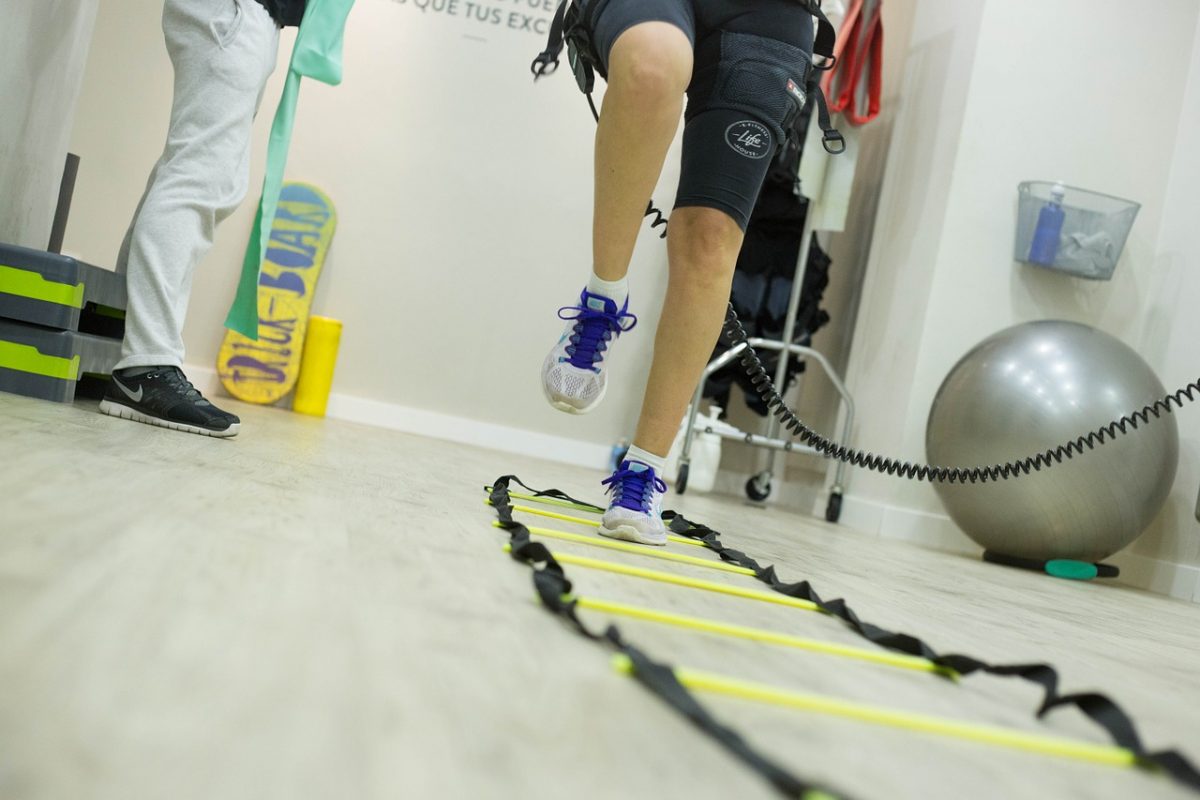
This training is based on inducing muscle contractions using appropriately selected electrical impulses . Most often, a special suit is used for this purpose, in which simple exercises are performed, and thanks to EMS currents, their effectiveness is significantly increased. EMS training accelerates fat burning, muscle mass building and cellulite reduction. EMS currents are also used in physiotherapy, especially in diseases whose symptoms are muscle weakness and atrophy.



