

Pain in the groin or hip area is something that can make life miserable - when walking, running and sometimes even sitting. Most often we look for the fault in the hip joints, the spine, maybe the abdominal muscles. But rarely do we think about a group of muscles that work like oxen every day and yet are ignored - the adductors. These medial thigh muscles can give symptoms that resemble completely different ailments. So how do you recognise if it is overloaded adductors that are the problem?
What do the adductors do and how are they overloaded?
The adductor muscles are a group located on the inside of the thigh - the long, short, great, slender and crestal adductors. Their main function is to pull the thigh towards the other leg (adduction), but also to stabilise the pelvis during movement. They work non-stop: when you walk, stand up, sit, run and even when you stand on one leg.
Overloaded adductors most often result from chronic muscle tension and imbalance. Sedentary lifestyle? Running without adequate preparation? Doing squats without controlling the movement? All of these lead to an accumulation of tension. At some point, the muscle can't stand it and starts to react with pain or restricted movement.
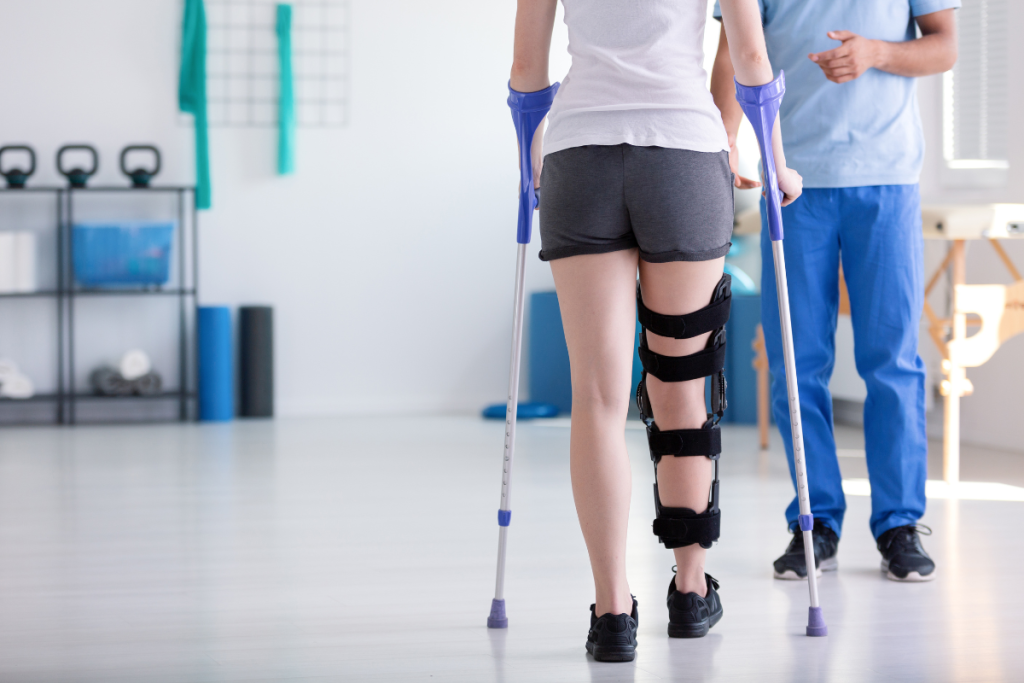
Problems with pain, strain or instability in the lower limb? Rehabilitation of the lower limb helps restore proper movement, strength and control.
Overstressed adductors - what symptoms can accompany the strain?
Overloaded adductors can give a wide variety of symptoms - often not obvious:
- pain in the groin, exacerbated when standing up, walking or when twisting the trunk,
- a "pulling" sensation along the inside of the thigh,
- restriction of the range of movement in the hip joint (e.g. difficulty putting the leg over the leg),
- tenderness on compression of the adductor muscles,
- Radiation of pain to the knee or lower back.
Interestingly, overloaded adductors can also masquerade as 'hip pain', even though the hip joint itself is perfectly healthy. Sometimes it is only a manual examination by a therapist that identifies the culprit.
Overloaded adductors - step by step diagnosis and therapy
Before you start stretching anything that hurts in the groin area, it's worth understanding exactly where the problem is coming from. Overstretched adductors require a specific approach - no haphazard massaging or 'by feel' selected exercises. Here's what the step-by-step diagnostic and treatment process looks like:
- History and analysis of symptoms
The first step is to gather accurate information: when the pain occurs, what aggravates it, how long it lasts. This helps to distinguish overloaded adductors from other possible causes of groin pain. - Manual and functional examination
The therapist will assess muscle tone, hip mobility and movement patterns. He or she will check if the adductor muscles are tender, shortened or react with pain on activation. - Differential diagnosis
Sometimes it is necessary to rule out other problems - hernia, hip pathology, lumbar spine overload. If necessary, imaging studies are performed. - Manual therapy
Relaxing overloaded adductors (e.g. through fascial techniques, massage, needling) often brings quick relief. It is also very important to work on the supporting structures - e.g. the external rotators of the hip or the gluteal muscles. - Activation and stretching exercises
Without this, the problem will keep coming back. Therapy includes exercises to restore muscle balance, improve movement control and pelvic stability. Eccentric exercises for the adductors are particularly important. - Training adaptation and load modification
Sometimes all it takes is a small change in training technique, in the way you sit or in the frequency of your exercises to prevent relapses. The essence really is to understand that it is not just about stretching - but about conscious muscle control.
Do you have complaints of pain or muscle tension? Pinopressure is a therapy that combines palpation diagnosis with precise stimulation to restore balance and movement relief.
When is it worth consulting a specialist?
If groin pain persists for more than 7-10 days despite rest and gentle stretching - this is a signal that it will not go away on its own. Especially if you notice:
- increase in pain with activity,
- a "pulling" sensation when the trunk is twisted,
- restriction of movement in the hip,
- pain radiating into the knee,
- tenderness on the inside of the thigh.
Overloaded adductors can progress to a chronic condition and begin to affect movement patterns throughout the body. The earlier you address the problem, the shorter the road to fitness.
FAQ
Yes, especially if you sit for a long time and in a position with your knees bent - the muscles are then constantly tense.
As much as possible. The adductors stabilise the pelvis - if they are overloaded, walking becomes painful or 'stiff'.
Yes, but carefully. Stretching alone without activation and strengthening is often not enough.
Depending on the severity, from a few days to several weeks. With chronic overload even longer.
Yes - by consciously strengthening the pelvic and hip muscles, improving posture and avoiding training overload.



